
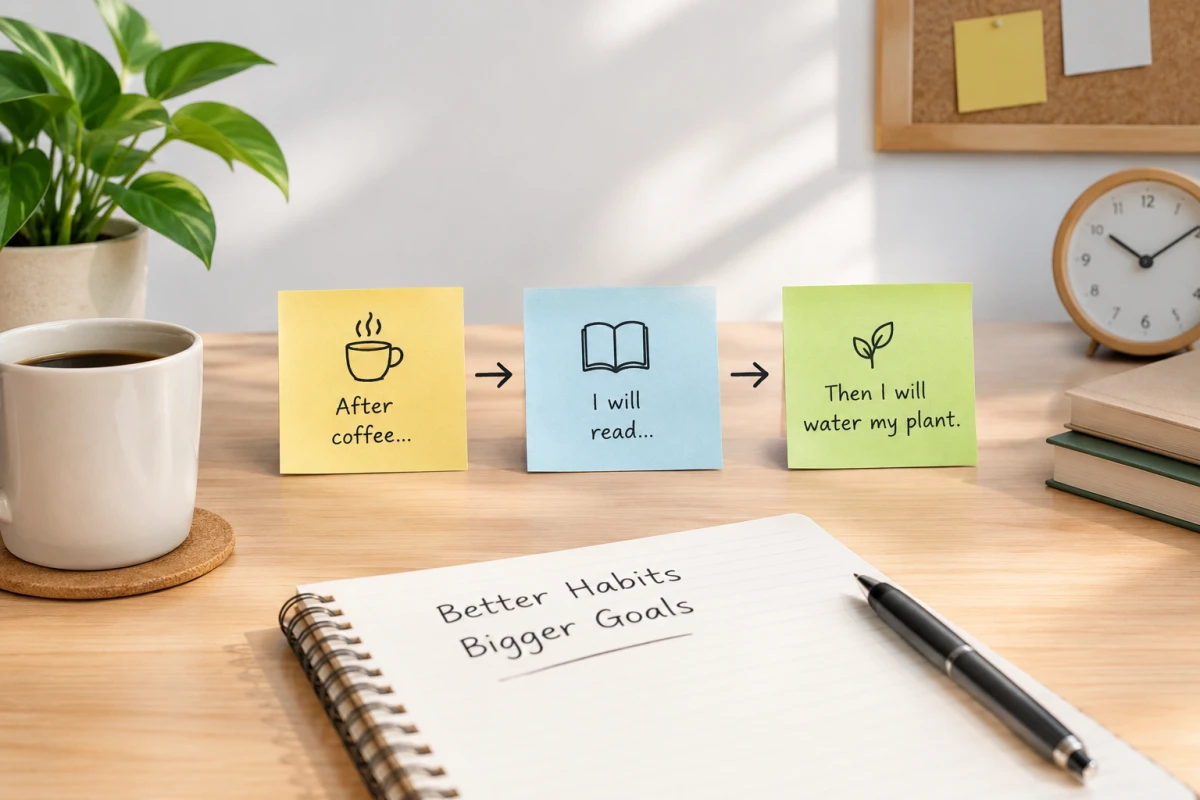
Habit stacking attaches a new habit to a routine you already have. Learn the formula, see examples, and find out what recent research says about making good habits last.
Habit stacking is a way to build a new habit by attaching it to a routine you already follow. The existing routine acts as an anchor, or trigger. The technique has drawn fresh attention throughout 2026, from health media to employee wellness newsletters.
James Clear popularized the term habit stacking in his 2018 book Atomic Habits. The basic idea comes from BJ Fogg, a behavior researcher at Stanford, who calls it anchoring in his Tiny Habits method. Outside magazine recently reported that psychologist Craig Kain has used the technique in his clinical practice for years.
According to Kain, willpower often gets in the way of lasting change. Habit stacking removes that obstacle because the trigger is already in place. You don’t have to force yourself to remember. You just finish one routine and move on to the next habit.
An Easy Habit Stacking Formula
Clear sums up the technique in one sentence: After I [current habit], I will [new habit]. For example, after I pour my morning coffee, I will write one sentence in my journal. The formula forces you to pick a clear time and place.
Choose an anchor that happens almost every day, has a clear beginning and end, and takes place in the same location. Brushing your teeth, making coffee, or sitting down at your desk all qualify. The frequency should match, too, so a daily habit needs a daily anchor.
The March 2026 edition of Marquette University’s employee wellness newsletter offers similar examples. Drinking a glass of water, stretching for one minute, or taking a short walk can all be attached to a daily routine. Habits this small are easier to keep because they don’t take much time.
Fogg recommends keeping a new habit under two minutes in the early stages. He also suggests celebrating that small win, for example with a smile or a fist pump. According to a review by The Meaning Movement, habits form more slowly without that celebration.
What the Research Says About Habit Stacking
Direct scientific evidence for habit stacking is still limited. The Boston Globe reported in April 2026 that Katy Milkman, a professor at the Wharton School, has not found a large study proving it works. Still, Milkman says the technique fits with theories of habit formation.
Milkman explains that consistent repetition is the most important ingredient in forming a habit. A daily trigger from an old habit helps you repeat the new behavior more often. Another source, Persaud, adds that research on behavioral therapy shows people stick better to habits that are prompted by a cue.
The main reference on how long habits take to form is a study by Phillippa Lally and her team at University College London. They followed 96 people for 84 days and published the results in the European Journal of Social Psychology. On average, participants needed 66 days for a new behavior to feel automatic, with a range of 18 to 254 days.
Lally also found that missing a single day made no significant difference. Participants who were highly inconsistent did not manage to form a habit. Exercise took about one and a half times longer than eating or drinking habits.
An analysis in The Behavioral Scientist cautions that the 66-day figure is the median among participants who succeeded. They made up about 48 percent of the group. So treat that number as a rough guide, not a promise.
How to Apply Habit Stacking Step by Step
Start with just one stack. List the daily routines that are already automatic, then pick one as your anchor. Attach one small habit right after it.
Keep your supplies near the anchor. If your anchor is making tea, store your vitamins next to the kettle. The first step feels easier when the tools are in plain sight.
Add a second habit only after the first one feels automatic. The Griply app’s guide warns that stacking too fast can make both old and new habits shaky. Increase the duration or intensity gradually.
Here are a few example formulas you can use:
- After I wake up, I will drink a glass of water.
- After I brush my teeth, I will stretch for one minute.
- After I sit down at my desk, I will write down my three priorities for the day.
- After I eat dinner, I will read one page of a book.
If you miss a day, check whether your anchor is weak, then swap it for a more stable trigger. Record each success on a calendar or in a tracking app. A visible chain of checkmarks helps you monitor how consistent you are with habit stacking.
Read more articles and interesting information only at bacatulisan.com