
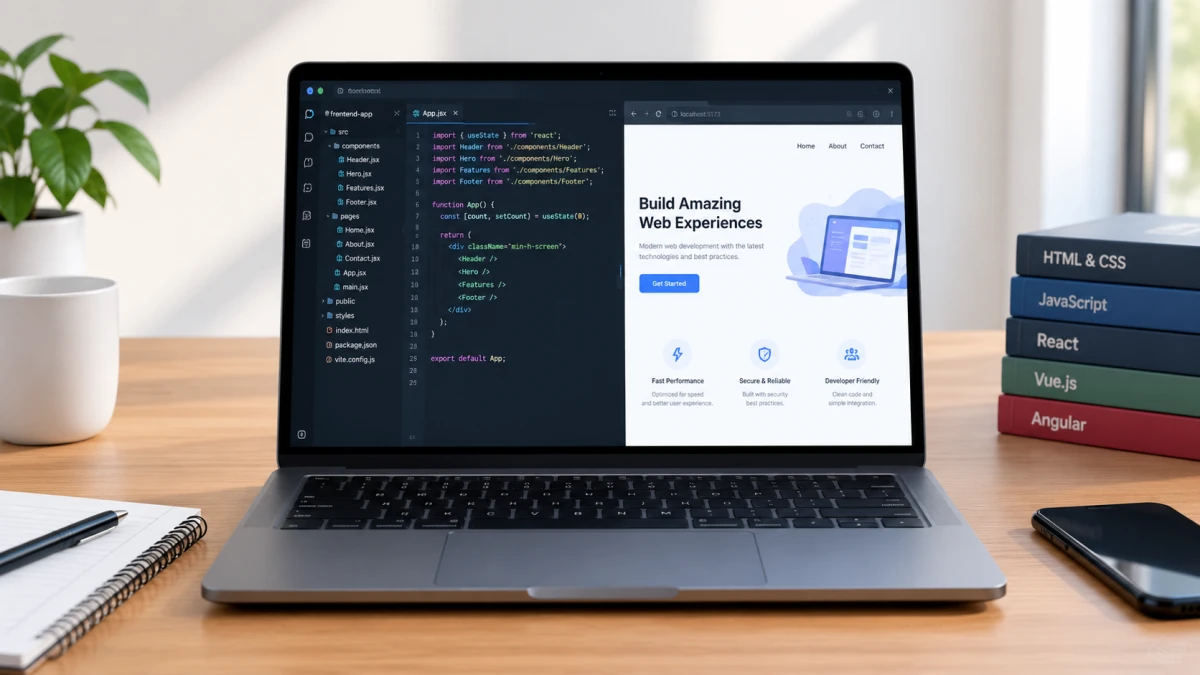
Not sure which frontend framework to learn first? Compare React, Vue, and Angular by learning curve, bundle size, ecosystem, and job opportunities.
Frontend Frameworks for Beginners: Choose React, Vue, or Angular
Choosing a frontend framework as a beginner can be confusing. There are three main options: React, Vue, and Angular. Each has a different character, architecture, and target audience.
A frontend framework helps developers build an app’s interface faster and more neatly. Developers don’t have to write everything in plain HTML, CSS, and JavaScript, and the project structure is more organized.
BuildWithAngga compared the three in a guide published in November 2025. Salman Rizky wrote the guide, and Taufan Fatahillah edited it. Here is a summary.
Getting to Know React, Vue, and Angular
React is a library created by Meta. Developers are free to decide on the project structure and choose their own supporting tools, like working with a big box of LEGO. Facebook, Netflix, and Tokopedia use React, so there are a lot of job openings for it.
That freedom has a downside. Beginners can get confused when setting up the project folders. They also have to install a router and state management separately.
Vue is maintained by the community and is a progressive framework. Its syntax is simple, and its documentation is the best organized of the three. The template, style, and script live in one file with a clear separation.
Vue has a smaller market share than React. As a result, there are fewer Vue job openings in some regions.
Angular was created by Google and is a full framework for enterprise projects. The router, state management, HTTP client, form handling, and build system are all available from the start. Its architecture is strict and based on TypeScript.
Angular has the steepest learning curve. It is also less suited to small projects.
Comparison and How to Choose
The table below summarizes the technical differences between the three. This data helps you weigh frontend frameworks for beginners against your learning needs.
| Parameter | Angular | Vue | React |
|---|---|---|---|
| Type | Full framework | Progressive framework | Library |
| Backed by | Community | Meta | |
| Learning curve | Hard | Easy | Moderate |
| Performance | Fast | Very fast | Fast |
| Bundle size | ~500KB | ~80KB | ~120KB |
| Data binding | Two-way | Two-way | One-way |
| Popularity | High | Medium to high | Very high |
| Best for | Enterprise apps | Rapid prototyping | Maximum flexibility |
Vue stands out for ease of learning and the smallest bundle size. React stands out for flexibility, ecosystem, and industry demand. Angular offers the most complete set of features, but it demands the most preparation.
Choose based on your goal. Want to land a job quickly? Pick React. Want a smooth learning process? Pick Vue. Want a career at a large company with fixed architectural standards? Pick Angular.
Once you’ve chosen, study one framework consistently for one to two months. Start practicing right away by building a small project. This approach makes frontend frameworks for beginners easier to master.