
Micro-credentials vs. online course certificates: which is more relevant for your career? Read the differences, 2026 survey data, and tips for choosing the one that fits your target job.
The debate over micro-credentials vs. online course certificates is coming up more often among job seekers. Both can be studied online, but employers don’t always see them as equal.
Recent data from Coursera shows which way things are shifting. Its 2026 Micro-Credentials Impact Report is based on a survey of more than 3,500 respondents in seven countries. Globally, 98 percent of employers already use skills-based hiring in some form. In Indonesia, the figure is 97 percent.
Differences Between Micro-Credentials and Online Course Certificates
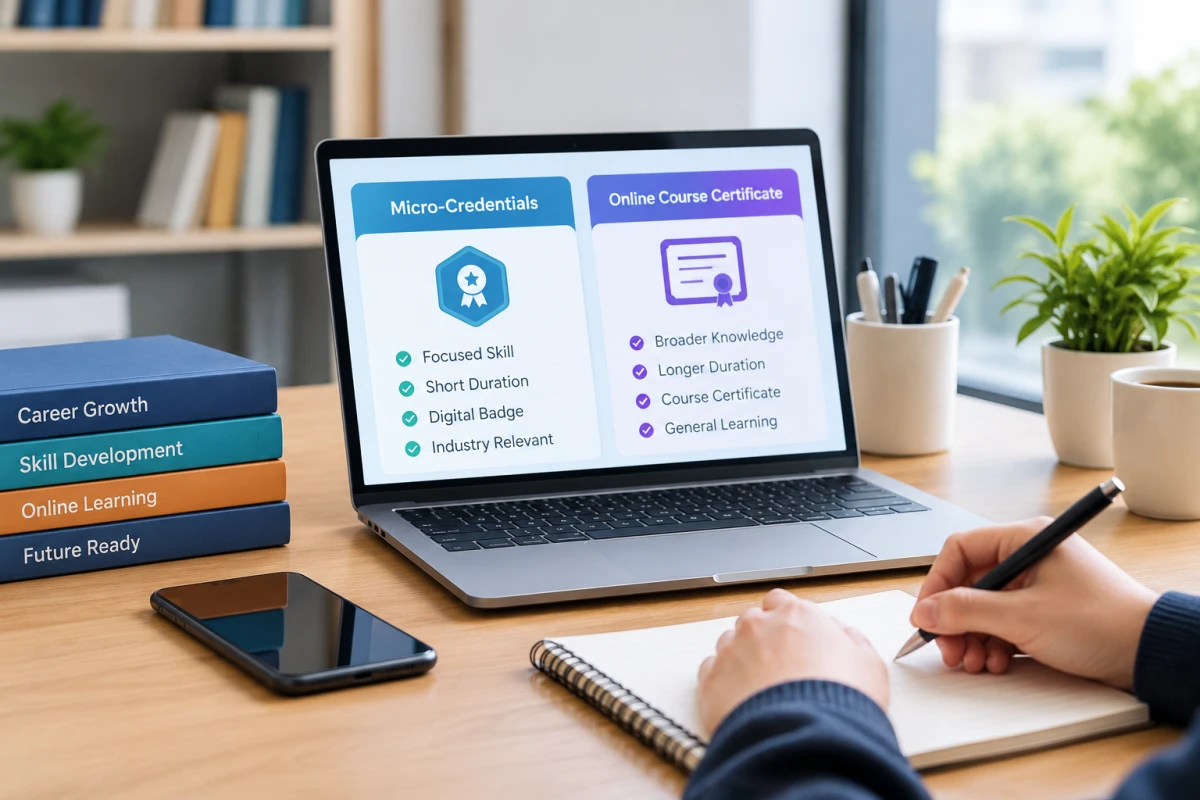
Micro-credentials are short, competency-based credentials that prove mastery of one specific skill. They usually take 5 to 40 hours of study and are assessed through evidence. Not every online course qualifies as a micro-credential, no matter how good the instructor is.
Online course certificates usually cover a broader field. They have a medium duration and moderate cost, while micro-credentials are shorter and cheaper. This type of certificate works well for learning the basics of a field, so you should check whether the course uses an exam or a project.
The Open Badges 3.0 standard from 1EdTech includes cryptographic signatures for skills-based credentials. With this standard, employers can verify a credential’s authenticity directly. A certificate you print yourself from an online course has no verification metadata like this.
| Aspect | Micro-credentials | Online course certificates |
|---|---|---|
| Focus | One specific skill | A broader field |
| Duration | About 5 to 40 hours | Medium, depends on the program |
| Cost | Lower | Moderate |
| Verification | Can be based on a digital standard | Depends on the provider |
| Academic credit | Available in some programs | Rare, depends on the university |
The Latest Data From Employers
In the comparison of micro-credentials vs. online course certificates, the numbers from employers are fairly clear. Globally, 94 percent of employers are willing to offer a higher starting salary to graduates with micro-credentials. In Indonesia, 96 percent of employers say the same. In addition, 87 percent of employers consider these credentials very important in hiring decisions.
The quality of the credential also affects the outcome. About 58 percent of employers trust micro-credentials more when they carry academic credit, and 82 percent place more value on credentials developed with industry partners. On the learner side, 82 percent say credentials that include projects are better aligned with real work.
Indonesian students are 8.8 times more likely to take micro-credentials that are recognized for academic credit. A study by LPEM FEB UI found that internship experience and competency certificates shorten the job search by up to 3.6 months. In other words, proven evidence of competence has real value in the local job market.
These figures should be read critically, since Coursera sells micro-credential products. Sertifier cites a 2025 TestGorilla survey in which 85 percent of employers said they use skills-based hiring. However, hiring data shows a figure of only 0.14 percent. Some employers are also still unsure about micro-credentials.
Micro-Credentials in Indonesia
Padjadjaran University (Unpad) launched the Unpad Luhung Micro-Credential Program on April 23, 2026. The program is open to participants from outside Unpad, with courses worth two to three credit units (SKS). Pelita Harapan University offers more than 60 micro-credential courses through its Center for Teaching and Learning.
SEAMEO SEAMOLEC and the ICE Institute Consortium held a regional policy dialogue on micro-credentials in Jakarta on June 8, 2026. Katadata reports that Ministerial Regulation No. 39 of 2025, amended by No. 10 of 2026, governs quality assurance in higher education. An opinion writer at Katadata argues that recognition should be designed from the start together with universities, industry, and professional associations.
The challenges include the pace of technological change, unequal access to education, and affordability. For this reason, you should choose a provider carefully. Universities, established platforms such as Coursera and edX, and large companies such as Google and Microsoft are considered safer choices.
How to Choose the Right One for Your Career
Start with your goal. If you want to switch careers or apply for a specific position, choose micro-credentials with real assessments and projects. If you only want an introduction to a new field, a regular online course certificate is enough.
Check four things before you pay:
- Issuer: a university, a major platform, or a company known in the industry.
- Assessment: a graded exam or project, not just watching videos.
- Verification: a digital credential that employers can check through a link.
- Credit: whether a university may recognize it as academic credit units (SKS).
Employers assess skills through work tests, simulations, competency-based interviews, and work samples. So keep a portfolio of every project you complete, and add the link to your digital credential on your CV and LinkedIn.
Choose a credential that matches the job you are aiming for. Make sure it includes assessments, projects, and digital verification. In the comparison of micro-credentials vs. online course certificates, these requirements decide which one is more relevant to your career.
Get the latest information and more useful articles at bacatulisan.com