
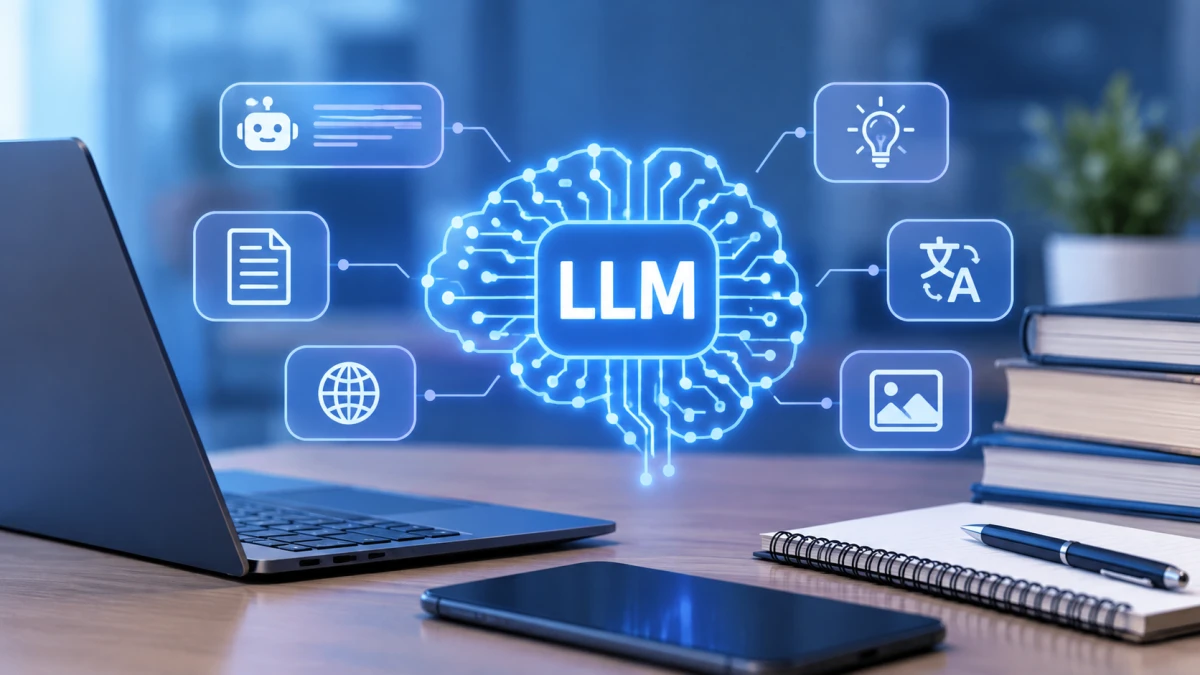
A large language model (LLM) is the technology behind ChatGPT, Gemini, and Claude. Learn what LLMs are, how they work, and how they help in everyday life.
Large Language Model (LLM): The Technology Behind Modern AI Chatbots
A large language model, or LLM, is the technology behind modern AI chatbots such as ChatGPT, Gemini, and Claude. The term literally means a model of language at a very large scale.
Developers train LLMs on huge amounts of text, from millions to billions of words. From that data, the model learns to recognize sentence patterns. As a result, an LLM can write new text that resembles human writing.
The learning process is similar to someone who reads every book in a large library. From all that reading, the LLM learns how words relate to one another. For example, it knows that a sentence beginning with “Once upon a time...” usually opens a story. The model can also continue the lyrics of a popular children’s song.
How an LLM Builds Sentences
An LLM works by predicting the most relevant next word. When it receives an input, the model first analyzes the sentence. It then chooses the next word based on statistical probability.
That probability depends on how often a word appears in the training data. The phrase “once upon a sunny day” has a higher probability than “once upon a furious day.” This is why the text the model produces feels natural.
The model calculates how words relate to each other using parameters, which take the form of weights and biases. A single LLM can have millions to billions of parameters. These parameters measure how well one word fits with other words in a sentence.
Model architecture has also changed over time. Earlier models processed words one by one in sequence, so they struggled to understand long sentences. The Transformer architecture, with its self-attention mechanism, solved that problem.
| Aspect | Earlier Architectures | Transformer Architecture |
|---|---|---|
| Processing method | Words are processed one by one in sequence | Each word is processed using a self-attention mechanism |
| Context range | Short; struggles to understand long sentences as a whole | Longer, from paragraphs to entire documents |
| Meaning alignment | High risk of losing meaning in complex sentences | Each word’s weight is measured against all other words in the sentence |
How LLMs Help in Everyday Life
LLMs boost work productivity. Text-based research that once took days or weeks can now be finished in a few hours. Replies to customer questions that used to take hours now take minutes, or even seconds.
LLMs also sharpen users’ creativity. Users must write precise prompts to get the results they want, and this process builds language skills. People still need to review and refine text produced by an LLM. That critical evaluation pushes users to create new written work.
In terms of accessibility, LLMs help break through language barriers and physical barriers. Google Translate translates languages across cultures. Live Caption displays text in real time on streaming platforms and video conferences for Deaf friends. Be My Eyes helps people with visual disabilities access visual information and text.